
OUTCOME
This work increased combined Monthly Active Users (MAU) across mobile surfaces and People You May Know from a projected ~35K to ~270K, representing a ~235K incremental lift beyond forecast.
Beyond user growth, the more meaningful impact was on signal quality and system performance:
- Increased the volume of high-confidence user interactions at key decision points
- Reduced ambiguity in how users identify, connect and engage
- Strengthened downstream systems that rely on consistent participation signals (e.g. ranking, recommendations and ads)
Using typical Average Revenue Per User or Unit (ARPU) benchmarks for platforms like Meta Platforms, this level of incremental MAU corresponds to an estimated:
- $9M–$35M in annualized revenue impact
- Excluding additional gains from retention, network effects and improved targeting efficiency.
These estimates are directional, but reflect how improvements in active user volume and signal reliability translate into monetization at scale.
Why this mattered
This work did not simply increase traffic. It improved the legibility of users within the system.
At scale, platforms operate on probabilistic identity. Small increases in clarity at the interaction level compound into:
- More accurate user representation
- Better system predictions
- Higher-value ad delivery
By improving how users understood and responded to key prompts, this work increased not just participation, but the quality and reliability of the data generated through that participation.
problem
Users were hesitant to upload phone contacts to facebook
CONTEXT
On the Address Book team at Meta (part of the Signals team that collects people data like emails and phone numbers), I partnered with the People You May Know team for a content experiment.
GOAL
• Increase contact uploads, drive MAU.
• Initial projections estimated ~35K MAU from contact uploads.
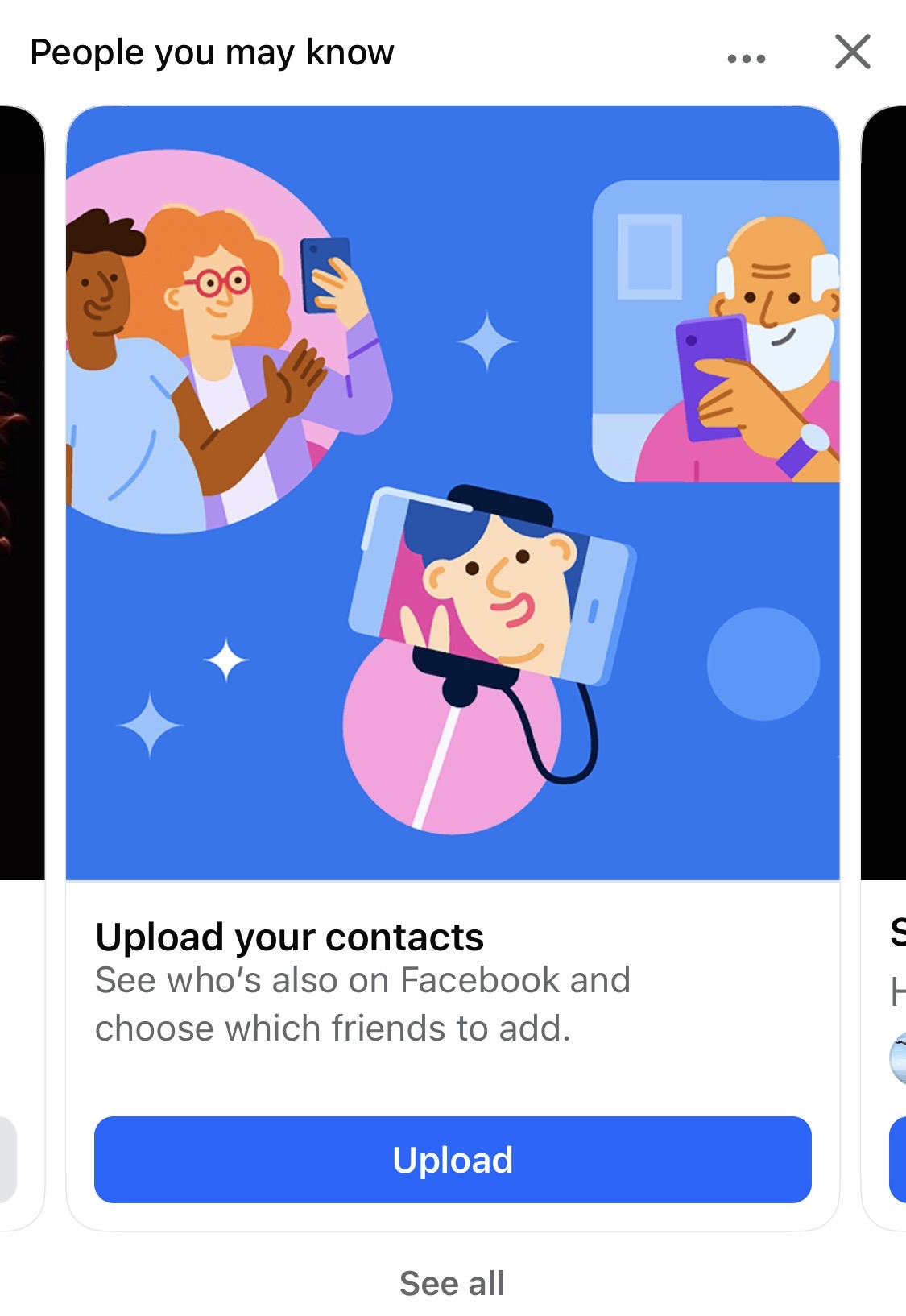
This content surfaced on a carousel tile on desktop and mobile, seen by tens of millions of users.
Role
- Aligned content with product intent and user understanding
- Wrote five initial variants for A/B testing
- Rewrote the final shipped version under strict UI constraints
- Partnered with engineering to ensure precise implementation
APPROACH
Previous content versions were centered around the phrase continuous contact uploading and didn’t explain the benefits of this action in plain words.
There was also always an intermediate set of progressive disclosure that explained how contacts were uploaded and how to remove permissions to do so later, if they chose to upload. That content didn’t change.
This experiment wasn’t just about shortening copy. It was about removing hesitation and building trust.
Users were being asked to take a multi-step action, but the previous content versions didn’t fully explain the initial decision of this flow, which is:
- Upload contacts from their device.
- See which of the people from their address book are on Facebook.
- Choose who to add as a friend.
That gap eroded people’s trust, which created uncertainty and inaction.
The final content:
- Made the value exchange immediately clear.
- Clarified what would happen after tapping the button.
- Focused on the user’s benefit in a high-visibility but low-attention surface.
Users are more willing to share when the path is clear and the explanation feels trustworthy. Every word has a job.
Constraint
Midway through testing, the content no longer fit the UI. My engineer called me and I rewrote the final version ad-hoc.
It had to work within:
- A shorter headline
- Two lines of body text max
- A CTA aligned with the headline
No space for extra explanations.
Impact
- Projected: ~35K MAU
- Result: ~180K MAU on Friends Home, ~90K MAU on People You May Know (iOS and Android)
An intentional, constrained content change drove a significant increase in engagement at scale. This version was chosen as the new default content in 2023 and it’s still the default today.
Takeaway
At scale, content is not just a layer of communication. It supports the mechanism for stabilizing how users are understood within the system.
Users don’t hesitate because they lack intent. They hesitate when the system feels ambiguous or untrustworthy. By increasing clarity at a key interaction point, this work reduced that ambiguity, enabling more consistent participation and more reliable downstream signals.
That increase in signal quality is what ultimately drives system performance and monetization.
Team
PMs, People You May Know and Signals engineers, Address Book content designer (me)
Project Timeline
5 days for A/B tests
Tools
Figma, content standards, UI element library + standards
A: 9-question Online Survey | typeform
Quantitative Research
responses
READ THE FULL REPORT >
(you won’t believe how many people track their 💩 !)
B: Observations | real social situations
Qualitative Research
years
occasions
C: Remote video interviews | Zoom
Qualitative Research
people with celiac disease
THE TWO PERSONAS >
that materialized after the research